Categories
Uncategorized

Is Your Marketing Budget Working as Hard as You Are?

Budget planning has a way of turning marketing into a numbers exercise. Teams review last year’s spend, adjust for new priorities and eventually arrive at a figure everyone can live with. But the most important decisions often happen before the spreadsheet is finalized.

A marketing budget is ultimately a reflection of where an organization intends to go. If the business wants to enter a new market, strengthen its reputation, launch a product, reach a new audience or generate more qualified leads, the marketing strategy, and the resources behind it, need to support those ambitions.

Before asking how much to spend, organizations should be asking a more important question: What do we need our marketing to accomplish?

Start With Direction, not Dollars.

One of the easiest approaches to budgeting is to take last year’s numbers and use them as the starting point for next year. The problem is that businesses don’t stand still.

Customers change. Competitors change. New technologies emerge. Business priorities shift. A company that spent heavily on brand awareness last year may need to focus on lead generation this year. Another may be entering a new market where it has little recognition. A third may be preparing for a major product launch or expansion.

Your marketing budget should reflect where the business is headed, not simply where it has been.

Before allocating dollars, define business priorities for the coming year and determine what role marketing and communications need to play in achieving them. This creates a much stronger foundation for deciding what deserves greater investment, what should remain consistent and what may no longer be serving the business.

Look at What’s Actually Working

Budget planning is also an opportunity to take an objective look at performance. Ask:

  • Which campaigns generated meaningful engagement?
  • Where did qualified leads originate?
  • Which content continued attracting attention months after it was published?
  • Did earned media improve visibility in priority markets/audiences?
  • Did trade show activity generate relationships, opportunities or sales conversions after the event?
  • Which channels consistently supported broader business objectives?

Just as importantly, identify what didn’t deliver.

Not every initiative needs to generate an immediate financial return to be valuable. Brand awareness, reputation, thought leadership and relationship building often generate value over a longer period. The important question is whether each investment has a clearly defined purpose and a meaningful way to evaluate whether it is contributing to the broader objective.

The goal isn’t necessarily to cut anything that can’t demonstrate an immediate ROI, but to understand what each investment is intended to accomplish and whether it is doing its job. It’s not about doing more but about investing more deliberately.

Think Beyond Individual Tactics

Marketing budgets are often divided into categories: PR, social media, advertising, events, content, creative, digital and so on. While that may make sense on a spreadsheet, audiences don’t experience brands that way.

Someone may discover your company through an industry article, visit your website, follow you on LinkedIn, see you at a trade show and eventually receive an email from your sales team. Each interaction influences the next.

Rather than evaluating every activity independently, consider how investments can work together as part of an omnichannel approach.

A single thought leadership initiative, for example, could become an article, media pitch, LinkedIn content, newsletter feature, sales resource and speaking opportunity. A trade show investment can extend well beyond the booth through pre-show media outreach, social content, customer communications and post-show follow-up.

When marketing activities reinforce one another, the value of the original investment can stretch considerably further.

Leave Room for Opportunity

No matter how carefully a marketing plan is built, the year rarely unfolds exactly as expected.

A relevant news story may create an unexpected media opportunity. A new platform may become important to your audience. A partnership, event or business opportunity may emerge that wasn’t on the calendar six months earlier.

A budget that allocates every dollar before the year begins can make it difficult to respond.

Building some flexibility into the plan allows marketing teams to capitalize on opportunities without having to abandon existing priorities or seek new approval every time circumstances change.

Strategic planning provides direction. Flexibility helps organizations stay responsive along the way.

Set a Direction

The most important element of budget planning is ensuring it’s aligned with what the organization is trying to achieve. Budget season is an opportunity to assess what’s working, challenge assumptions and make deliberate choices about where marketing can have the greatest impact.

When asking yourself, ‘what do we need our marketing to accomplish?, the answer should guide where every dollar goes. Instead of building next year’s budget around where your business is today, build it around where you want to be tomorrow. When every investment supports that direction, every marketing dollar has the opportunity to work harder.

At Zenergy, we help organizations integrate marketing and communications so that strategy, performance, and positioning are expressed with clarity, consistency, and credibility.

Zenergy Communications
info@zenergycom.com

Categories
Uncategorized

From Search Results to Direct Answers: Why AEO Matters in the New Era of Business

The way people search has fundamentally changed. We no longer have a tendency to type a few keywords into Google, scroll through a page of links and decide which website to visit. Increasingly, we simply ask a question and expect an answer.

Google Featured Snippets, People Also Ask, AI Overviews, voice assistants and generative AI platforms are all contributing to this shift. Instead of directing users somewhere else to find information, these tools increasingly provide the information directly.

For brands, that creates a new challenge. Getting found is still important, but what happens when the searcher never makes it to your website? That’s where Answer Engine Optimization (AEO) comes in.

What is AEO?

AEO is the practice of structuring and presenting online content so that search engines and AI-powered platforms can easily identify, understand and surface it as a direct answer to a user’s question.

Think about the difference between searching ‘commercial lighting trends’ and asking ‘what are the biggest commercial lighting trends architects should consider?’

The second query requires more than matching keywords. The platform needs to understand the question, identify credible information and formulate a useful response. AEO helps make your content easier to select for that response.

The objective therefore isn’t simply to rank highly. It’s to become a credible source of the answer itself.

Why AEO is Becoming More Important

In our previous article on SEO and zero-click search, we explored how users are increasingly finding what they need without visiting a website. That behavior has only become more important as conversational AI has grown.

People are no longer limiting themselves to traditional search engines. They’re asking increasingly specific questions through AI assistants and other conversational interfaces, often refining those questions through a series of follow-ups.

For businesses, visibility is consequently becoming less about appearing on a page of results and more about whether your expertise makes its way into the answer.

A company can have excellent information buried within a 1,500-word article. But if the answer to a specific question is difficult to identify, interpret or extract, an answer engine may look elsewhere.

Start With the Questions Your Audience is Actually Asking

AEO requires a slight shift in how organizations approach content strategy; traditional keyword research asks ‘what terms are people searching for?’ while AEO asks ‘what are people trying to find out?’

Here’s the best part: you likely already know the kinds of questions your customers aren’t just asking AI. Speak to your sales team and find out what questions they repeatedly get asked, what questions come into customer service and what does your technical team explain over and over again?

Those conversations can provide a roadmap for useful content.

For example, instead of creating a broad article about sustainable building materials, a manufacturer might answer specific questions such as:

  • What makes a building material sustainable?
  • How do environmental certifications differ?
  • What should architects consider when comparing materials?
  • How can material selection contribute to green building objectives?

Each question creates an opportunity to provide a clear, authoritative answer while demonstrating expertise in the broader subject.

Make the Answer Easy to Find

Good AEO doesn’t mean reducing every topic to a one-sentence response. Complex subjects still require context, nuance and expertise. But it does mean making the core information easy to identify.

If someone asks a straightforward question, answer it early. Then provide the explanation, evidence and context that make the answer useful.

Strong headings also matter. Organizing content around the questions people actually ask helps both readers and search technologies understand what information is available.

FAQs, definitions, step-by-step explanations, comparison content and clearly labelled sections can all make information easier to interpret and extract.

The same principle applies to writing itself. Clear language generally works better than unnecessarily complicated terminology. If a subject requires technical language, define it rather than assuming every reader will understand what you mean.

Don’t Write for Robots

As new optimization acronyms emerge, there’s a risk that businesses begin creating content primarily for algorithms. That’s the wrong takeaway.

AEO ultimately rewards content communications professionals should already be striving for: answering real questions clearly and usefully.

A technically optimized page that offers little original value isn’t going to build trust with a potential customer. Neither will dozens of generic FAQ pages created simply to capture search queries. The strongest AEO content starts with genuine expertise and then structures that expertise so it can be easily understood.

Ask the question your audience is asking. Give them a useful answer. Support it with credible information. Then make it easy to find.

SEO, GEO and AEO Need to Work Together

SEO, GEO and AEO are often discussed as competing strategies, but businesses shouldn’t be choosing between them. Each addresses a different aspect of how people now discover information.

  • SEO helps your content get found.
  • AEO helps your content answer specific questions.
  • GEO helps your brand and expertise become visible within generative AI responses.

There is considerable overlap between them. Clear site architecture, useful original content, authority, structured information and a strong digital presence can contribute to all three.

The difference is what you’re optimizing for.

The Next Phase of Search is About Being Useful

For years, digital visibility was largely measured by rankings, clicks and website traffic. Those metrics still matter, but as more searches are answered before someone reaches a website, businesses need to consider whether their expertise is visible within those answers.

That changes the question from simply ‘are people finding our website?’ to, ‘Is our expertise helping shape the answer?’

It starts by understanding what your audience genuinely wants to know and creating content that addresses those questions with clarity, authority and useful information.

As search continues to evolve, the most visible brands will be those that consistently provide credible, useful answers. Being found still matters, but increasingly, being the source of the answer matters too.

At Zenergy, we help organizations integrate marketing and communications so that strategy, performance, and positioning are expressed with clarity, consistency, and credibility.


Zenergy Communications
info@zenergycom.com

At Zenergy, we help organizations integrate marketing and communications so that strategy, performance, and positioning are expressed with clarity, consistency, and credibility.


Zenergy Communications
info@zenergycom.com

Categories
Uncategorized

2027 SALARY INCREASES: CANADIAN BUDGETS PROJECTED TO HOLD STEADY

  • Average increases of 3.1% projected for 2027.
  • 46% of organizations plan to secure additional budgets to address compensation challenges.
  • Employers are securing increases to apply market-driven adjustments, differentiate compensation for top performers, and retain employees in critical roles.

Toronto, Ontario,  September 1, 2026 – Normandin Beaudry, a leader in actuarial and total rewards consulting services, released the findings of its 16th annual Salary Increase Survey with more than 800 Canadian organizations participating in this 2027 edition. Results indicate that Canadian organizations are maintaining a consistent salary increase budget from previous years, with an average increase of 3.1% expected in 2027 (excluding salary freezes). This number aligns with actual budgets in the past year.

“After continued reductions in salary budgets in recent compensation cycles, salary increases have been trending back toward pre-pandemic levels since 2025”, said Darcy Clark, Senior Principal, Compensation, Talent and Culture, at Normandin Beaudry. “The 2027 projections indicate alignment with 2026 budgets despite economic, trade and geo-political uncertainties.”

HIGHLIGHTS

Additional salary budgets are still in play to support compensation issues

While salary increase budgets stabilize, organizations continue to carve out additional funds to address any pressures that may arise to due to market conditions. In 2026, approximately 46% of responding organizations allocated an additional 0.9%, on average, beyond their general salary increase budget. Normandin Beaudry’s 2027 survey results indicate that this trend holds steady, as 46% of Canadian organizations plan on granting the same average additional budget of 0.9% for the upcoming year’s compensation cycle. Among other purposes, these budgets will be used to apply market-driven adjustments, differentiate compensation for top performers, and retain employees in critical roles.

Industry sectors reporting high increases

For 2027, the following sectors reported higher-than-average salary budget increase expectations:

  • Telecommunications, data processing, data warehousing and related services: 3.4%
  • Finance and insurance: 3.4%
  • Real estate, rental and leasing: 3.3%
  • Technology: 3.3%
  • Construction: 3.3%
  • Professional, scientific and technological services: 3.2% 

Projections indicate that despite Canada experiencing what economists call a ‘technical recession’, organizations are planning consistent salary increase budgets as reported in 2026.

The full report and interactive tool, with details by province, industry sector, size and type of organization, are available on the Normandin Beaudry website.

Read our one pager In the spotlight to learn what Canadian organizations had to say about AI adoption, future skills, evolving compensation practices and the strategic role of HR in this transformation.

About Normandin Beaudry

Canadian excellence in total rewards

Founded in 1992, Normandin Beaudry is recognized for its leading-edge total rewards consulting services. Independent and wholly owned by an ever-growing number of its professionals, Normandin Beaudry has an ownership structure that puts it in a unique position as one of the few major firms in the field with exclusively Canadian interests, while also standing out through its B Corp certification. From offices in Montreal, Toronto and Quebec City, a team of nearly 400 employees serves an enviable list of clients across Canada that includes organizations of all sizes and industries from the private, public, para-public and not-for-profit sectors.

Excellence spans the globe! As an independent and equal shareholder in MBWL International since 2023, Normandin Beaudry’s reach now extends to 50+ countries.

About our Compensation, Talent and Culture Expertise 

Normandin Beaudry’s team of over 60 Compensation, Talent and Culture consultants is one of the largest in Canada. Through the sound and innovative use of data and technology, our versatile and creative experts provide clients with unique and simple solutions that address their strategic and operational needs. For more details, visit https://www.normandin-beaudry.ca/en/areas-of-expertise/compensation/

– 30 –

Media contact:

Zenergy Communications

media@zenergycom.com   

Categories
Uncategorized

Part 2: How to Turn Your Showroom or Trade Show Booth into a B2B Sales and Education Platform

Support Your Sales Team Through Design

An intentional layout creates natural opportunities for conversation while eliminating common barriers to engagement.

Create different environments that support different stages of the buying journey:

  • Open areas that encourage casual conversations
  • Demonstration spaces where products can be experienced
  • Semi-private meeting areas for technical discussions
  • Comfortable seating for longer specification conversations

When the space supports the conversation, sales teams spend less time directing traffic and more time building relationships.

Think Beyond the Event

One of the biggest missed opportunities is treating a trade show as a two or three-day event when in reality, it should be the beginning of a much longer marketing campaign.

Every showroom launch or trade show can generate valuable content before, during and after the event, including:

  • Video walkthroughs
  • Product demonstrations
  • Customer interviews
  • Social media content
  • Media coverage
  • Educational webinars
  • Blog articles
  • Follow-up email campaigns

Measure Success Differently

Lead counts will always matter, but they don’t tell the whole story. Success should also be measured by indicators that reflect education and relationship building, including:

  • Time spent engaging with visitors
  • Number of meaningful conversations
  • Technical consultations conducted
  • Follow-up meetings booked
  • Specification requests received
  • Distributor introductions
  • Continuing education participation
  • Media engagement
  • Content generated from the event

These metrics provide a much clearer picture of how effectively your space supports long-term business development.

Bringing It All Together

Whether it’s a permanent showroom or a trade show booth, every physical space represents an opportunity to communicate your brand. When thoughtful design meets strategic communications, a showroom becomes a destination for education, collaboration and lasting business relationships.

Manufacturers that create environments where visitors can learn, ask questions, experience products firsthand and leave with greater confidence in both the solutions and the company behind them will be the ones that stand out.

This article was developed collaboratively by Zenergy Communications and SH Design Build. Zenergy helps manufacturers build stronger brand identities and connect with key audiences through its strategic marketing communications engagement platform, A&D Link, while SH Design Build specializes in designing immersive showrooms, tradeshow booths and commercial environments. Together, they help manufacturers create spaces that not only showcase products, but also educate, engage and drive business growth.

Interested in learning more about how Zenergy and SH Design Build can help bring your next showroom or tradeshow booth to life?

Get in touch.

At Zenergy, we help organizations integrate marketing and communications so that strategy, performance, and positioning are expressed with clarity, consistency, and credibility.

Zenergy Communications
info@zenergycom.com

Categories
Uncategorized

pop-up go by Zenergy

pop-up go is Zenergy’s experiential retail and space-matching service. We connect listers (landlords and property owners) with seekers (retailers and brands) to unlock the power of short-term retail and pop-up spaces across North America.

What We Do

Matching: Strategic Space & Brand Connections

We connect Listers with curated and vetted brands seeking short-term spaces and Seekers with locations that are aligned with their goals/defined parameters.

Through our proprietary network and industry relationships, we identify opportunities that reflect audience demographics, location strategy, and business objectives.

We don’t just connect — we align.


Make It Pop: Full-circle Activation Strategy & Support

Beyond matchmaking, pop-up go offers strategic advisory and marketing support to help maximize activation impact.

Solutions include retail roadmap development, brand positioning, MARCOM strategies, PR, social, digital amplification, and experiential campaign integration.

We provide full-circle support or collaborate where needed, working as a seamless extension of your team.

Why pop-ups?

Pop-ups are more than just for temporary spaces. They are very useful for multiple purposes including testing markets, brand awareness, community engagement, revenue generation and experiential storytelling.

pop-up go combines real estate knowledge with marketing intelligence to ensure that activations are not only well placed, but well positioned.

LISTERS: Turn vacancy into visibility.

Lister benefits include short-term revenue generation, increased exposure for underutilized space, more/diversified foot traffic, flexible tenancy solutions and enhanced property perception.

SEEKERS: Test. Launch. Activate.

Benefits to Seekers include low-commitment market entry, expansion into new geographies, real-time consumer feedback, a platform for experiential brand storytelling, increased awareness, and business intelligence insights.

Backed by Zenergy

As part of Zenergy Communications, pop-up go is supported by deep expertise in marketing, media relations, retail strategy, and brand positioning. We understand how to align space, story, and strategy, ensuring each activation contributes to broader business objectives.

Let’s Make It Pop 

Looking to:

  • Lease your space?
  • Explore short-term retail opportunities?
  • Refine your brand strategy?
Categories
Uncategorized

Part 1: How to Turn Your Showroom or Trade Show Booth into a B2B Sales and Education Platform

For many manufacturers, a showroom or trade show booth represents a significant investment, yet often, these spaces are viewed as temporary displays or product showcases rather than strategic business assets.

Today’s B2B buyers — particularly architects, designers, specifiers and dealers — aren’t looking to be sold to. They want to learn. They want to solve design challenges, compare solutions, ask technical questions and understand how products perform in real-world applications.

When thoughtful spatial design is combined with strategic communications, a showroom or booth becomes far more than a place to exhibit products. It becomes a powerful platform for sales, education and long-term relationship building.

Design the Experience, Not Just the Space

The physical environment sets the tone long before anyone speaks. A well-designed showroom or booth should naturally guide visitors through a journey. Every element from the layout and lighting to product placement and meeting areas should support how people discover, interact with and understand your products.

Successful environments are designed around people, not products. An intuitive layout encourages exploration, creates opportunities for meaningful conversations and makes visitors feel comfortable enough to spend time engaging with your brand. Rather than simply maximizing visibility, the goal is to create a space that balances aesthetics, functionality and flow to support the entire customer experience. 

Think less about fitting in every product you manufacture and more about creating intentional spaces for demonstration, discussion and discovery.

Shift from Product Features to Customer Challenges

Many manufacturers organize their booths or showrooms around product categories. Instead, organize them around the problems your customers are trying to solve.

For architects and designers, that might include:

  • Designing healthier workplaces
  • Creating accessible environments
  • Improving sustainability
  • Maximizing storage in compact spaces
  • Supporting flexible learning environments
  • Enhancing user comfort and ergonomics

When visitors see products working together within a real application, they begin to understand not only what your products do, but why they matter. This approach transforms a showroom from a collection of displays into a learning environment.

Tell a Story That People Remember

Technical specifications remain important but they rarely create lasting impressions on their own. Storytelling does.

For manufacturers, storytelling might mean showing how your products contribute to greener buildings, simplify installation, improve occupant wellbeing or support sustainable construction. Rather than presenting products individually, demonstrate how they solve real design challenges within complete environments.

Create Opportunities to Learn

Education has become one of the most valuable tools in B2B marketing. Your showroom or booth should make learning easy through:

  • Live product demonstrations
  • Interactive displays
  • Working product installations
  • Material comparison stations
  • Digital specification tools
  • QR codes linking to BIM files and technical resources
  • Short educational presentations
  • Hands-on opportunities to experience materials and hardware

The more interactive the experience, the more memorable it becomes. This is especially important when engaging the architecture and design community, where product understanding often plays a critical role in specification decisions.

Stay tuned for part II coming soon!

This article was developed collaboratively by Zenergy Communications and SH Design Build. Zenergy helps manufacturers build stronger brand identities and connect with key audiences through its strategic marketing communications engagement platform, A&D Link, while SH Design Build specializes in designing immersive showrooms, tradeshow booths and commercial environments. Together, they help manufacturers create spaces that not only showcase products, but also educate, engage and drive business growth.

Interested in learning more about how Zenergy and SH Design Build can help bring your next showroom or tradeshow booth to life?

Get in touch.

At Zenergy, we help organizations integrate marketing and communications so that strategy, performance, and positioning are expressed with clarity, consistency, and credibility.

Zenergy Communications
info@zenergycom.com

Categories
Uncategorized

Fractional MARCOM: A Marketing Department Built for Growth. Not Overhead.

Strategic leadership and execution, without the cost and complexity of building a full internal MARCOM team.

Waiting for the right time to fix your marketing gaps? The reality is there’s no better time than right now. In fact, by putting it off, you may be losing visibility, potential leads, and market position.

Zenergy works as an extension of your organization to provide the strategy, content, digital marketing, design and communications support needed to build visibility and drive growth.

Most growing companies face the same problem: they know they need stronger marketing and communications, but building a full internal team is expensive, time-consuming and difficult to structure.

Zenergy’s fractional MARCOM team model provides: 

  • Strategic marketing leadership
  • North American market entry support
  • Multilingual content and thought leadership development
  • Digital marketing and social media
  • Design and brand support
  • Public relations and visibility initiatives
  • Internal communications support

The result is a structured, consistent marketing presence that supports your business goals.

How We Work

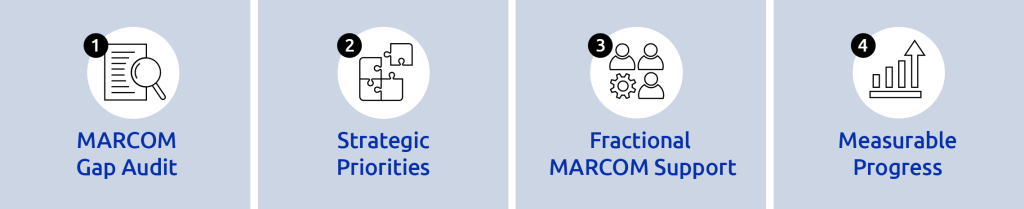
1. MARCOM Gap Audit. We begin with a short diagnostic of your current marketing and communications capabilities (most companies score below 25).

2. Strategic Priorities. Together we identify the most important areas to strengthen (i.e. messaging, visibility, content, digital presence or campaigns).

3. Fractional MARCOM Support. Our team integrates with your organization to deliver ongoing strategy and execution.

4. Measurable Progress. We track activity and results to ensure that the marketing and communications efforts support tangible business objectives.

We provide full-circle support or collaborate where needed, working as a seamless extension of your team.

MARCOM Gap Audit Assessment

Take Zenergy’s complimentary MARCOM Gap Audit Assessment and discover the opportunities to strengthen your marketing, communications, and business visibility.

Take the assessment

Categories
Uncategorized

Social Bootcamp: Strategies for Success

In the ever-evolving landscape of digital communications, social media has become one of the most valuable tools to help businesses grow and connect with their target audience. However, many have yet to even scrape the surface of its potential.

That’s where we come in.

Social Bootcamp isn’t just another training program; it’s a tailored solution crafted to empower your employees with the knowledge and skills needed to leverage social media effectively. Whether they’re novices navigating the basics or seasoned professionals seeking advanced sales strategies, our program helps to build confidence among participants and amplify your company’s messaging.

Customizable Training for Lasting Impact

One size doesn’t fit all when it comes to social media training. That’s why our program is fully customizable based on participant aptitude and company objectives, ensuring that each participant receives relevant and practical guidance. From platform-specific techniques to overarching strategies, we equip your team with the tools they need to succeed.

A Solution for Employee Engagement

Employee disengagement is an increasingly costly reality for businesses worldwide. In an era where remote work is the new reality, fostering a sense of community and connection is paramount. By empowering employees to become brand ambassadors through their online presence, companies can enhance both internal morale and external perception, fostering a community that transcends physical boundaries.

Harnessing the Power of Unified Messaging

In the realm of social media, consistency is key. Our program focuses on more than just the individual profiles; it instills a cohesive approach to messaging across the entire organization. By aligning employee interactions with corporate values and guidelines, we ensure that every post and comment reflects positively on your brand.

Amplifying Your Reach

Did you know that employee reach on social media can surpass corporate reach by as much as 561%? It’s a staggering statistic that underscores the potential impact of a well-trained team. Our program empowers employees to become active participants in amplifying your company’s message, driving engagement, and ultimately, conversions.

Next Steps

In a digital landscape where social media reigns supreme, staying ahead of the curve isn’t just advantageous—it’s essential. Our Social Bootcamp program offers a comprehensive solution for businesses seeking to harness the power of social media to drive growth, engage employees, and amplify their message. Join us in unlocking the full potential of social media and propel your company towards success.

Contact us to get started.

Categories
Uncategorized

Stakeholder Activism is Changing. Is Your Communications Strategy Keeping up?

For many organizations, stakeholder activism has traditionally been viewed through a governance lens and managed by the board, legal counsel, as well as investor relations teams when shareholder challenges emerge.

That perspective is becoming outdated.

Today’s activist landscape is broader, faster-moving, and far more public. Institutional investors, employees, customers, advocacy groups, regulators, and even online communities are increasingly influencing corporate decision-making. Their concerns extend beyond financial performance to include governance, executive compensation, sustainability, workplace culture, AI, cybersecurity, and long-term strategy.

In this environment, activism is no longer solely an investor relations issue. It is also a communications issue.

How an organization engages with stakeholders before, during, and after periods of heightened scrutiny can significantly effect shareholder confidence, corporate reputation, and long-term value creation.

Activism Rarely Begins with a Public Letter

When people think of shareholder activism, they often picture a public campaign, a proxy contest, or an open letter criticizing management.

In reality, activism usually begins much earlier.

Questions from institutional investors become more pointed. Analysts begin challenging strategic decisions. Employees raise concerns internally. ESG-focused investors seek greater transparency. Industry groups and advocacy organizations start shaping public conversations.

These early signals give organizations an opportunity to listen, engage, and respond before issues escalate.

The companies that navigate activism most effectively are often those that have established strong stakeholder relationships long before concerns become public.

Communication is No Longer Reactive

One of the biggest mistakes organizations make is treating stakeholder communication as something that happens only when pressure arises.

By that stage, stakeholders have often already formed their opinions.

Instead, leading organizations approach communication as an ongoing process of relationship-building. They engage investors regularly, communicate their strategy consistently, and create opportunities for meaningful dialogue throughout the year.

This proactive approach builds credibility over time and makes difficult conversations considerably easier when challenges arise.

Consistency Builds Confidence

As investor relations and corporate communications become increasingly interconnected, organizations must ensure they are telling one coherent story. Different audiences may require different levels of detail, but they should never hear conflicting versions of the company’s strategy.

Investors, employees, customers, journalists and regulators all consume information from multiple sources. Earnings calls become news headlines. Executive interviews are shared across social media. Internal communications are often compared with public statements. When those messages feel inconsistent, stakeholders notice.

Organizations that communicate with clarity and consistency are better positioned to maintain confidence, even when facing criticism or uncertainty.

Stakeholder Engagement is Becoming a Competitive Advantage

The strongest investor relations and corporate communications programs are increasingly centered on understanding stakeholder expectations, identifying emerging concerns, and creating ongoing dialogue with the people who influence long-term corporate success.

That means asking questions such as:

  • Are we hearing concerns before they become public?
  • Are our communications reinforcing the same strategic priorities across every audience?
  • Are we creating opportunities for meaningful engagement rather than simply delivering information?
  • Do stakeholders understand not only what we’re doing, but why we’re doing it?

Organizations that can answer ‘yes’ to these questions are often better equipped to navigate periods of scrutiny.

Preparation Extends Beyond Investor Relations

Preparing for stakeholder activism requires alignment across the organization. Investor relations, corporate communications, executive leadership, legal counsel, human resources and governance teams all play a role in shaping confidence.

Preparation may include:

  • Developing clear and consistent messaging around corporate strategy
  • Monitoring stakeholder sentiment and emerging issues
  • Training executives for difficult conversations and media interviews
  • Aligning internal and external communications
  • Establishing engagement plans for key shareholder groups
  • Creating response frameworks before they’re needed

Organizations that prepare collaboratively can respond more confidently and credibly when pressure emerges.

Looking Ahead

Stakeholder activism is unlikely to slow down. As expectations around transparency, governance, and corporate accountability continue to evolve, organizations will face increasing scrutiny from a broader range of stakeholders. The companies that respond most effectively will be those that have already invested in trust; trust built through consistent communication, meaningful engagement and a willingness to listen long before difficult conversations begin.

The Bottom Line

Stakeholder activism has evolved from an occasional governance challenge into an ongoing communications priority. Organizations that view engagement as a continuous process will be better positioned to maintain shareholder confidence, strengthen stakeholder relationships, and protect their reputations as expectations shift.

At Zenergy Communications, we help organizations align investor relations, corporate communications, and stakeholder engagement strategies to build credibility before it’s tested and communicate with confidence when it matters most.

How a company communicates with shareholders influences how it is perceived by the public. And how it is perceived by the public can shape investor confidence. The most effective organizations recognize this connection and ensure that their messaging is aligned across all audiences.

At Zenergy, we help organizations integrate IR and corporate communications so that strategy, performance, and positioning are expressed with clarity, consistency, and credibility.

Zenergy Communications
info@zenergycom.com

Categories
Uncategorized

GEO is Evolving: What Brands Need to Know in 2026

When we first explored the rise of AI-driven search in our SEO in the Age of AI blog series, much of the conversation focused on education and answered these fundamental questions: What is Generative Engine Optimization (GEO)? What does zero-click search mean? And how might AI change how people discover brands online?

One year later, the conversation has shifted.

AI-generated search is now actively shaping how people find information, compare options, and evaluate brands. According to BrightEdge, Google’s AI Overviews now appear in nearly half of all searches, while AI platforms such as ChatGPT, Claude, and Perplexity continue to gain popularity as alternatives to traditional search engines.


For brands, the question is no longer whether AI search matters. The question is: How do we ensure our brand is one of the few names AI systems choose to surface, summarize, and recommend?

SEO Still Matters – But Ranking Alone Is No Longer Enough 

Traditional SEO is far from obsolete. Technical performance, crawlability, structured content, and keyword relevance still matter. However, AI-driven search is changing what visibility actually means.

AI Overviews are appearing across an increasing number of searches, answering many users’ questions before they ever need to click through to a website. Research suggests that many AI-assisted searches now end without a click, meaning brands may technically appear in search results without ever becoming part of the final answer.

In other words, visibility does not automatically translate into selection. The brands most likely to appear in AI-generated responses are those that demonstrate authority, clarity, and consistency across multiple sources.s where GEO builds upon SEO. Rather than replacing traditional optimization, GEO expands it, shifting focus from simply being found to being understood, trusted, and confidently referenced.i

Brand Mentions Matter More Than Backlinks

SEO strategies heavily emphasize backlinks and domain authority but AI search appears to place increasing value on brand recognition across trusted sources.

An Ahrefs study examining thousands of brands found that unlinked brand mentions were among the strongest predictors of AI visibility. Why? Because generative search engines do not rank webpages in the same way traditional search engines do. They synthesize answers.

A claim made only on a company website may be interpreted as marketing. But when similar information appears consistently across media coverage, review platforms, industry publications, expert commentary, and third-party websites, it becomes easier for AI systems to treat those signals as credible.

This shift has important implications for communications strategy. PR, thought leadership, earned media, expert commentary, and industry visibility are no longer only as awareness tactics. They are also as discoverability strategies.

Brands that appear consistently across trusted environments are more likely to be surfaced in AI-generated search.and Mentions Matter

More Than BacklinksBrand Mentions Matter
More Than Backlinks

Generic Content is Losing Value 

The rise of AI has made content creation dramatically easier, and that is precisely the problem.

As more organizations publish AI-assisted content at scale, the internet is becoming saturated with material that sounds increasingly similar.

Audiences are beginning to notice. A recent Forbes Communications Council analysis points to growing signs of ‘AI fatigue,’ with audiences gravitating toward more original, human-centered communication. At the same time, platforms and search engines appear to be rewarding expertise, originality, and signals of human experience.

That might include:

• Original insights or opinions
• Lessons learned or behind-the-scenes experiences
• Proprietary research or data
• Specific examples, stories, or real-world context
• Thought leadership grounded in expertise

The implication is simple: AI can accelerate content production, but it cannot replace human perspective and experience.

Structure Matters More Than Ever

Creating strong content is only part of the equation. Brands also need to consider how content is structured.

AI search engines prioritize information that is easy to extract, summarize, and cite.

Content designed for AI visibility tends to share several characteristics:

• Clear answers to specific questions
• Strong headings and logical structure
• Shorter paragraphs and scannable formatting
• Definitions, summaries, or direct explanations
• Consistent language and terminology

Content also needs to be written for answerability, meaning it clearly answers specific questions upfront before expanding into deeper context.

The clearer and more structured your content is, the easier it becomes for AI systems (and people) to interpret and reference it. 

Highly technical language, vague messaging, and long, unstructured blocks of text are less likely to surface in AI-driven search. The best-performing content is often the clearest.

Looking Ahead

Organizations that more seamlessly integrate IR and PR into their communications strategy will be better positioned to build trust, strengthen market confidence and protect their reputation. Those that continue operating in silos risk creating confusion at precisely the moments when credibility matters most.

How a company communicates with shareholders influences how it is perceived by the public. And how it is perceived by the public can shape investor confidence. The most effective organizations recognize this connection and ensure that their messaging is aligned across all audiences.

At Zenergy, we help organizations integrate IR and corporate communications so that strategy, performance, and positioning are expressed with clarity, consistency, and credibility.


Zenergy Communications
info@zenergycom.com